

It’s possible to get more done if you change where you study. Even though many students have a nice desk and lots of books, they still find it hard to concentrate. Most of the time, the place, not the person, is the trouble. We’ll show you some easy ways to set up your study desk that will help you concentrate, stay organized, and enjoy your study time. You will find an idea that works for any size room.
Why Desk Placement Matters More Than You Think
Your brain connects places with habits. Your mind learns that this is a place to work when you always study in the same quiet place. That helps you get going and stay on task. The wrong place makes things worse. It’s not clear what to do when your desk faces a busy hallway, a loud TV, or a comfortable bed. This type of study desk will help you get work done by giving you good light, low noise, and not many other things to do. Every day, small changes in where you stand can save you time.
Where to Place a Study Desk: The Basic Rules
Before we look at specific rooms, here are the simple rules that help you decide where to place a study desk in any home:
- Pick a spot with good light, natural if possible.
- Stay away from loud areas like the kitchen or living room TV.
- Keep a power outlet close so cables do not stretch across the floor.
- Leave enough room to pull your chair out and sit comfortably.
- Choose a calm view, such as a wall, a plant, or a window, instead of a busy scene.
If a spot passes most of these rules, it is a strong choice. You do not need a perfect room. You just need a spot that works for you.
The Best Place for a Study Desk in Most Homes
The best spot for a study desk in most homes is a quiet area of a bedroom or an extra room. It’s easy to keep these areas private, and they’re close to your things. There is no need for a separate study room if you already have one. Find the quietest time of the day and the quietest part of the house if you share your home with other people. People are less likely to walk by and make noise at a desk in the back of the house. If you work in the middle of a path, people walking by will take your attention away from your work.
Study Desk Near Window: Light and Views
People like to study with their desk near a window for a good reason. Natural light can make you feel better and keep your eyes healthy. It also means you don’t have to use as many bright lamps during the day. Watch out for a few things. In a busy view, don’t face the window straight on; people, cars, and birds can draw your attention away. Instead, try putting the desk next to the window. It gives you light without a screen full of things to look at. If it’s really hot in the afternoon, put up a small screen to protect your book or laptop from the sun.
Study Desk Placement for Focus
Focus is all about removing what pulls you away. Good study desk placement for focus follows a few easy ideas.
Face a wall or a calm view. A plain wall keeps your eyes and mind quiet. You can add a small board with your weekly goals for a simple reminder.
Keep your back to less busy areas. If people often walk behind you, it can feel distracting even when you cannot see them. A corner or a wall behind you helps you feel settled.
Keep your phone out of reach. Place it on a shelf across the room or in a drawer. The desk position matters, but so does what sits on it.
Study Desk Placement in Bedroom
It can be very helpful to set up your bedroom so that you can learn there. The important thing is to make the desk area feel different from the bed area. It’s easier to switch between work and rest when your desk and bed feel like two separate areas. If you can, pick the wall that is the farthest from your bed. Mark the end of your study space with a rug, a shelf, or a small screen. If you put your study desk in your bedroom in the right place, you should also clean it up at nite so that your room is calm when it’s time to sleep.
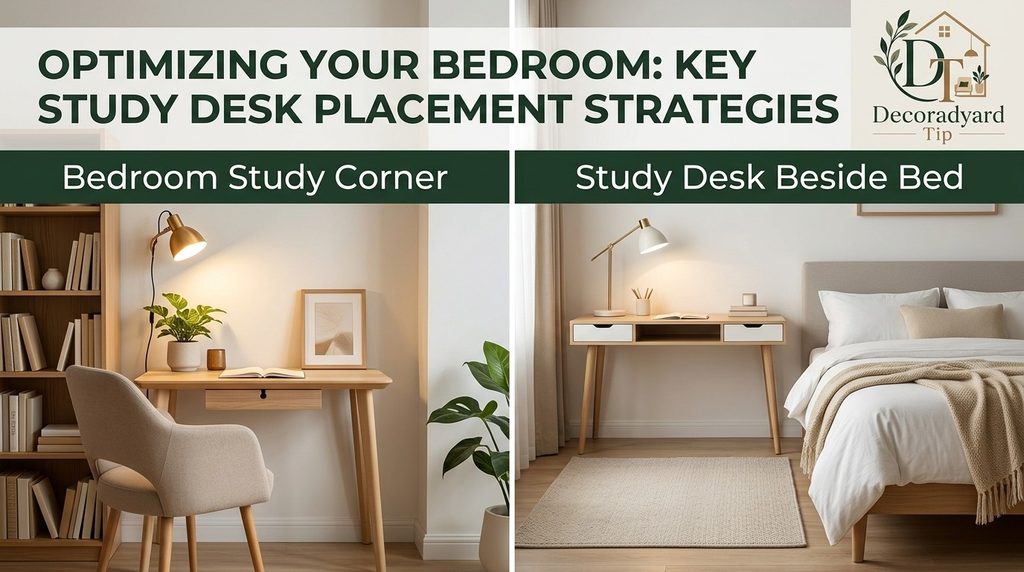
Study Desk Beside Bed
A reading desk next to the bed is sometimes the only option in a small room. People often do this in shared beds and college rooms. If you plan it well, it might work. While you study, turn the desk around so that you don’t have to face the bed. If you can, sit so that your back is against the desk or tilt it. This way, the bed won’t wake you up while you read. Don’t put pillows or clothes on the desk either, so it still feels like a place to work.
Bedroom Study Corner Ideas
Here are some ideas for a cozy bedroom study corner. Pick a corner that has two walls around it. Put in a small desk, a chair with good back support, and a bookcase on top. A clip-on light or wall lamp takes up less room on the table and gives off warm light. You can also feel alone in a corner. It gives you a small space to study alone, even if other people are using or working in the room. Putting a plant or framed picture there will make it a nice spot to sit.
Study Table in Bedroom Ideas
There are many ways to fit a study table in a bedroom, and you can pick the one that matches your room shape. Here are a few study table in bedroom ideas that are easy to try:
- Under a window: Gives light and saves floor space.
- Along a long wall: Works well for wide desks with shelves above.
- Between a wardrobe and a wall: Uses a gap that often goes unused.
- At the foot of the bed, facing the wall: Good for narrow rooms.
Whichever you choose, measure first. Leave at least a small walking path so the room does not feel crowded.
Corner Study Desk Ideas
One of the best places in any room is a corner. Corner study desk ideas let you make use of empty space and make you feel safe and at ease. You can use both sides with an L-shaped desk, which gives you more space for a laptop, notes, and books. If you want something lighter, put a chair close to two hanging boxes that meet in the corner. You can also put a regular square desk in the corner and add a tall shelf to one side to store things. It’s also easy to hide cords behind the desk when it has corners.
Study Table Ideas for Small Rooms
Small rooms need smart thinking, not a bigger budget. These study table ideas for small rooms save space and still support good habits:
- Wall mounted fold down desk: Opens when you study and closes when you are done.
- Narrow desk against a wall: Even a thin table can hold a laptop and a notebook.
- Desk with built in shelves: Stores books upward instead of outward.
- A desk that doubles as a dresser top: Clears space in tight rooms.
Also think vertically. Wall shelves, hooks, and pin boards keep your things off the desk and make your space feel bigger.
Compact Study Desk Setup
A compact study desk setup is all about keeping only what you need within reach. Try this simple layout:
- Place your main work item, like a laptop or notebook, in the center.
- Keep pens, sticky notes, and a water bottle on one side.
- Put books you use today on a small shelf above or beside you.
- Store everything else in a drawer or a box away from the desk.
A small desk stays useful when it stays clear. At the end of each study session, take two minutes to reset it. This tiny habit makes tomorrow’s start much easier.
Study Table Position: Facing Wall or Room?
Where you put your study table relies on who you are and how much room you have. If it’s easy for you to get sidetracked, face a wall. If a wall makes you feel squished, face the room or sit so that a window is on the side. Take a week off from each and see how you feel. To read deeply, many people find it helpful to face a wall. For artistic work and online classes, many people find it helpful to face the room. There is no one right answer; just do what works best for you.
Desk Positioning Ideas That Keep You Organized
Good ideas for where to put your desk can help you organize as well as focus. Place the things you use most often near the things you can reach the quickest. Put books and other things you don’t use as often higher up on the shelves. For writing, keep your strong hand free. With your right hand, write. Place the lamp on the left side so that your hand doesn’t cast a shadow. Put pens in a small tray and things that need to be done in a folder. It only takes seconds to clean up when everything has a place to go.
Productive Study Space Ideas to Try This Week
Here are a few productive study space ideas you can try without buying anything new:
- Move your desk away from the TV or door.
- Add a lamp that lights your work area evenly.
- Clear the desk except for today’s task.
- Set a start time and use the same spot each day.
- Add a small plant or a calming picture for comfort.
Small steps like these build a space that supports good habits.
Your Best Study Desk Setup Checklist
Use this quick list to check the best study desk setup for your home:
- Is there good light, ideally natural?
- Is the spot quiet and free of foot traffic?
- Can you sit for a long time without back or neck strain?
- Is your phone out of sight?
- Does the desk feel separate from your bed or sofa?
- Are your supplies close and neat?
Decoradyard Tip: Study Desk Placement Ideas
At Decoradyard Tip, we share practical and inspiring ideas for creating beautiful, functional spaces, from Study Desk Placement Ideas and Folding Desk Ideas to home décor, organization, and interior design tips. We also welcome contributors through our Write For Us opportunity and provide professional Guest Posting, Content Writing, and Backlinks services to help brands and businesses build their online presence. For publishing opportunities, collaborations, or service inquiries, Contact Us today and connect with Decoradyard Tip.
Final Thoughts
To study well, you don’t need a big room or a fancy desk. You need a place that has good light, little noise, and a clear line between work and play. Try putting your study desk in a few different ways and keep the ones that work. You should find it easier to sit down, stay focused, and finish your work on time in about a week.